
This post contains affiliate links. Read our affiliate disclosure here.
If you’re tired of nagging, negotiating, and repeating yourself 47 times a day, this DIY chore and behavior chart for kids might be exactly what your home needs.
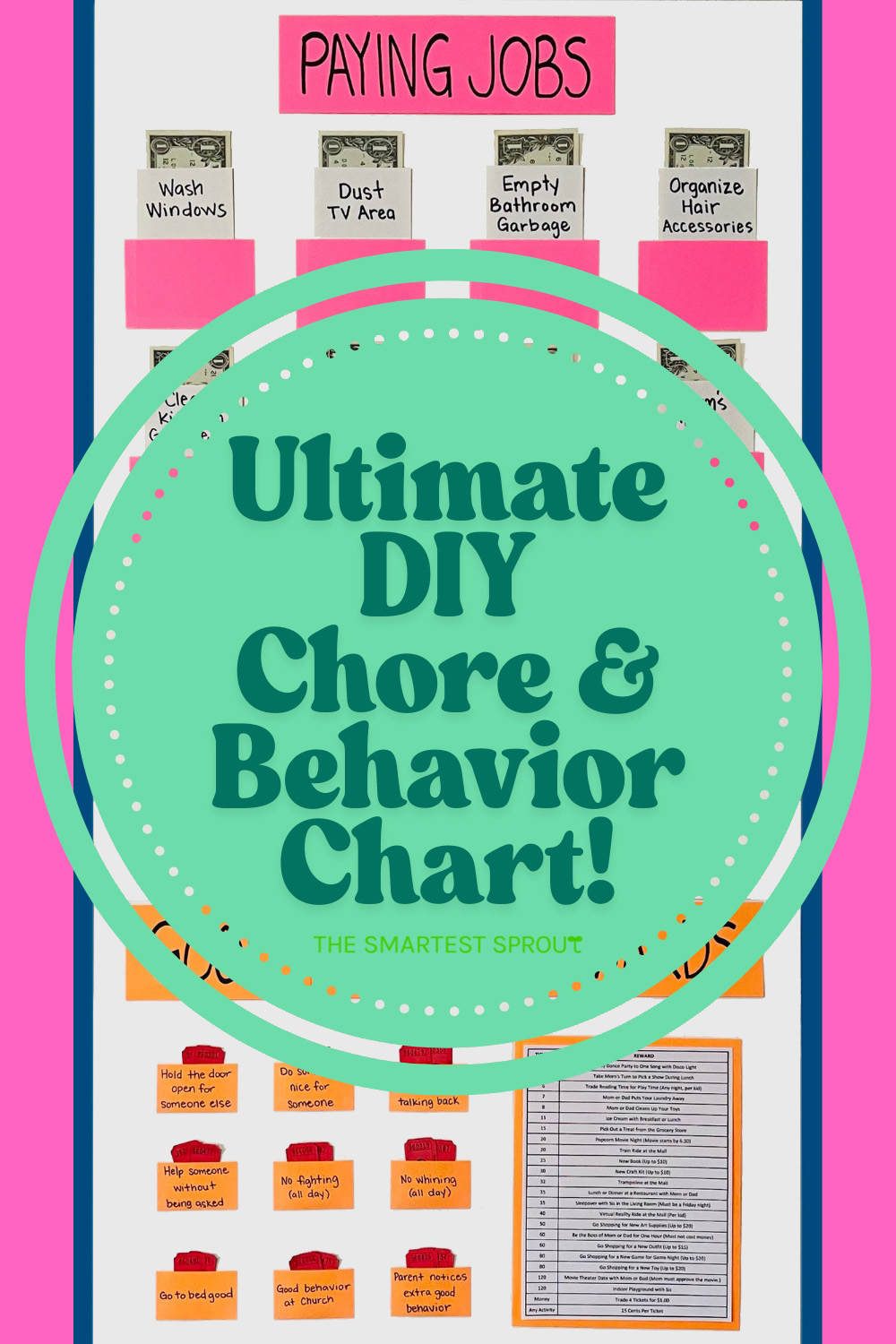
This isn’t a cute printable that gets ignored after a week. It’s a powerful, visual system that combines chores, incentives, screen time rules, and sibling fairness into one clear structure. And because everything is visible and consistent, kids quickly understand what’s expected without constant reminders.
Why Most Chore Charts for Kids Stop Working
A lot of chore charts fail because they:
-
Only focus on chores
-
Don’t separate required tasks from optional earning
-
Lack consistency
-
Rely only on punishment
-
Don’t address real-life friction points like screen time or turn-taking
Kids need clarity. They need to see what’s expected and what happens next. That’s exactly why a DIY chore and behavior chart for kids works better than a simple checklist.
When everything is verbal, it becomes a power struggle. When it’s visual, it becomes predictable.
What Makes This DIY Behavior Chart Different
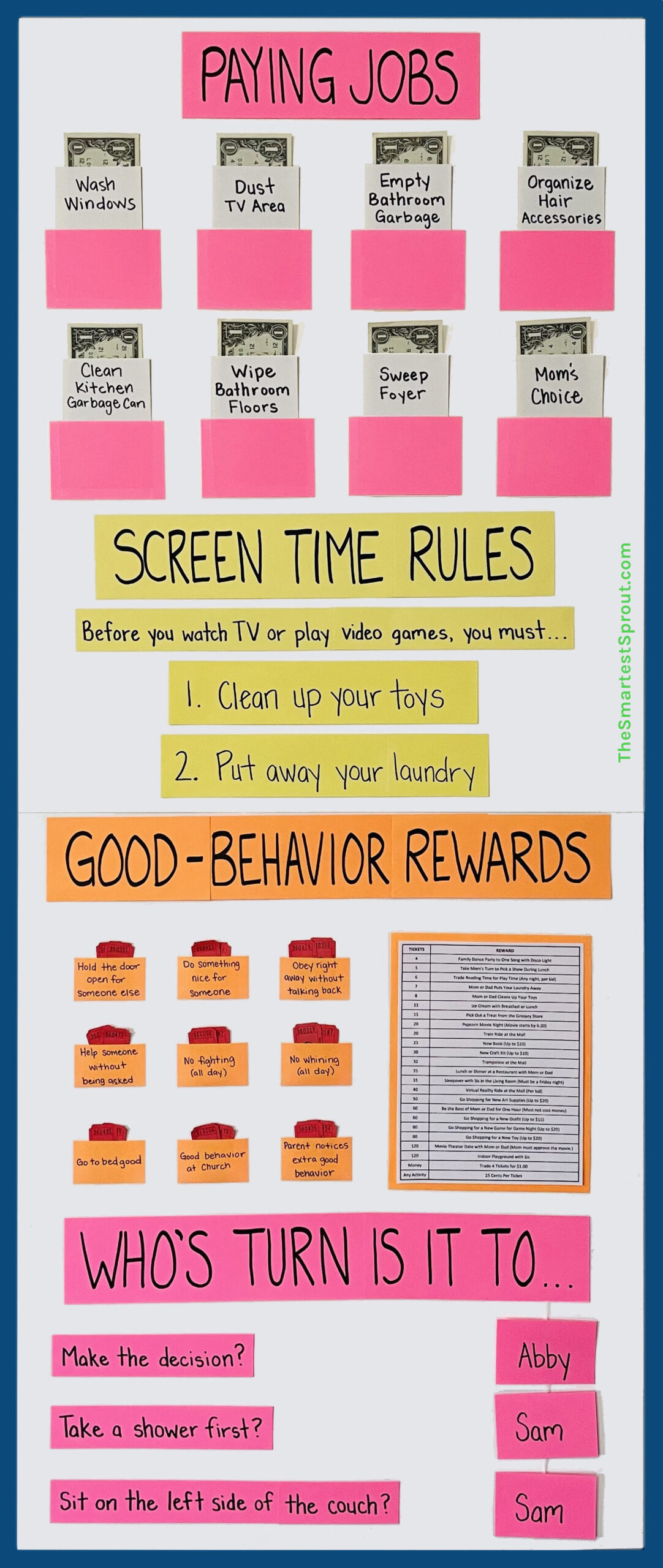
This chart is divided into four sections that address everyday parenting pain points.
1. Paying Jobs
This section includes optional extra tasks kids can complete to earn money. You decide what job cards go with which dollar amounts, and kids can pick and choose at their leisure.
Examples:
-
Wash windows
-
Organize a closet
-
Vacuum the car
-
Deep clean a bedroom
This teaches:
-
Work equals reward
-
Initiative matters
-
Money is earned, not handed out
It also helps kids learn basic responsibility around earning.
2. Screen Time Rules
This might be the most powerful section. Instead of constantly arguing about devices, expectations are posted clearly.
Before screens are allowed, specific tasks must be completed. No ifs, ands, or buts.
For example:
-
Clean up toys
-
Put away laundry
When it’s written down, there’s no debating what “clean enough” means. It removes emotion from the conversation.
3. Good Behavior Rewards
Positive reinforcement works better than constant correction.
This section includes small rewards that can be earned through consistent effort. Your kids can earn tickets for practicing certain good behaviors and save up the tickets to buy rewards.
Ideas:
-
Pick the family movie
-
Choose dinner
-
Stay up 15 minutes later
-
Earn tickets toward a larger reward
The goal isn’t bribery. It’s reinforcing habits you want repeated.
4. Who’s Turn Is It?
If you have multiple kids, this section eliminates daily arguments. The flaps rotate to show the name of the child who’s turn it is to do something next.
Post answers to questions like:
-
Who picks the show
-
Who sits in the front
-
Who goes first
-
Who chooses the game
When it’s visible, fairness feels objective. No more “That’s not fair!”
How to Build the DIY Chore + Behavior Chart (Step by Step)
Step 1: Gather Supplies
You don’t need anything fancy and you should already have most of these items around the house.
-
Two large poster boards 22″ x 28″
-
Black permanent marker
-
3″ x 5″ index cards
-
Colored cardstock
-
Clear tape
- Packing tape
- Painter’s tape
-
Durable string or twine
-
Ruler
- Scissors and/or paper cutter
- Dollar bills
- Microsoft Excel (Optional)
These simple materials are all you need to build this DIY chore and behavior chart for kids from scratch.
Step 2: Tape the Two Poster Boards Together to Make One Tall Board
- Lay both poster boards face down on the floor or large table, with the bottom board overlapping the top board about 1/8″ so that there is not a crack showing.
- Line up the edges so they match up evenly and form one tall board. Make sure you line them up so that the short edges are touching each other. This should be a very tall behavior chart.
- Place packing tape along the seam on the back.
- Create a decorative border by taping on strips of cardstock paper. (Optional)
- Flip the boards over (front side up).
- Add either one strip of packing tape across the front seam if desired.
Step 3: Create Your Section Headers
You’ll make four bold header strips, each are 3″ high:
-
Paying Jobs
-
Screen Time Rules
-
Good-Behavior Rewards
-
Who’s Turn Is It To…
- Cut large colored rectangles for each header.
- Write each title in large, bold letters.
- Tape each header to the board using clear tape.
Step 4: Build the Paying Jobs Section (Money Pockets)
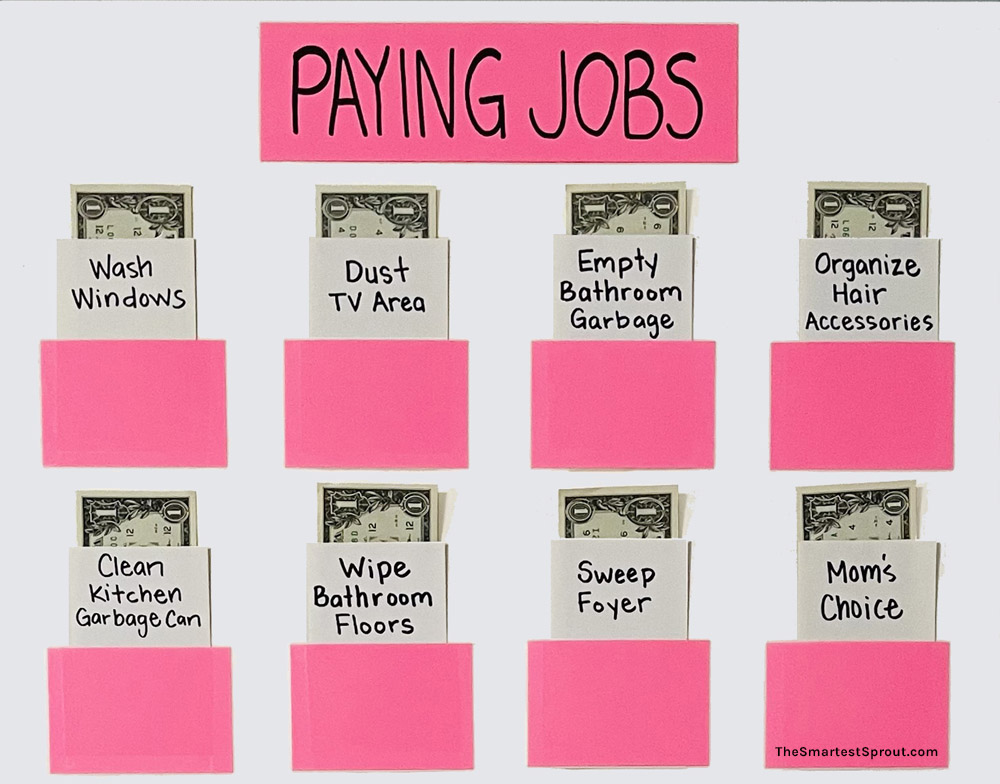
This section uses paper pockets cut from cardstock, sized to hold an index card and a dollar bill in each one. This section is about 17 1/8″ in height.
- Tape the “Paying Jobs” header at the top of the section.
- Cut 8 colored squares out of cardstock, 4″ wide x 2 3/4″ high.
- Arrange the squares neatly, in two rows of four. Leave enough space above each for the dollar bills to stick out without crowding.
- Tape the pockets onto the board, only taping the right, left, and bottom edge of each pocket.
- Write one job on the top half of each index card. You can use the examples below or create your own.
- Place one job card and one dollar bill in each pocket.
If you need help coming up with job ideas, here are a few I use in our home:
- Wash Windows
- Dust TV Area
- Empty Bathroom Garbage
- Organize Hair Accessories
- Clean Kitchen Garbage Can
- Wipe Bathroom Floors
- Sweep Foyer
- Mom’s choice
Step 5: Build the Screen Time Rules Section (Two-Step Checklist)
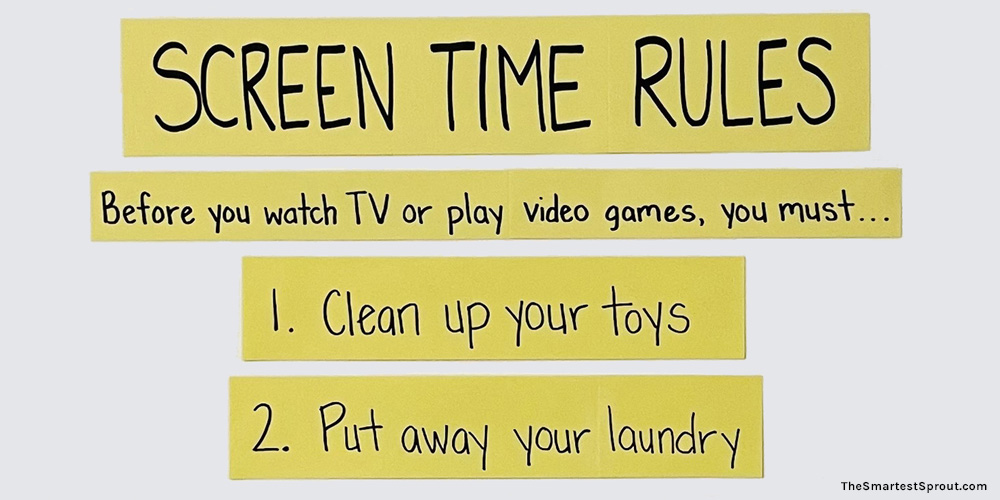
This is a simple “you must do this before screens” list. This section is about 10 3/4″ high. Make sure to modify the screen time prerequisites to fit your family’s needs.
- Tape on “Screen Time Rules” header at the top of the section.
- On a strip of cardstock 1 1/2″ high, write “Before you watch TV or play video games, you must…”. Tape that strip below the section header.
- Using two more cardstock strips 2 1/4″ high, write your two screen time prerequisites and tape each one onto the chart.
If you need help coming up with screen time prerequisite ideas, we use the ones below:
- Clean up your toys
- Put away your laundry
Step 6: Build the Good-Behavior Rewards Section (Ticket System)
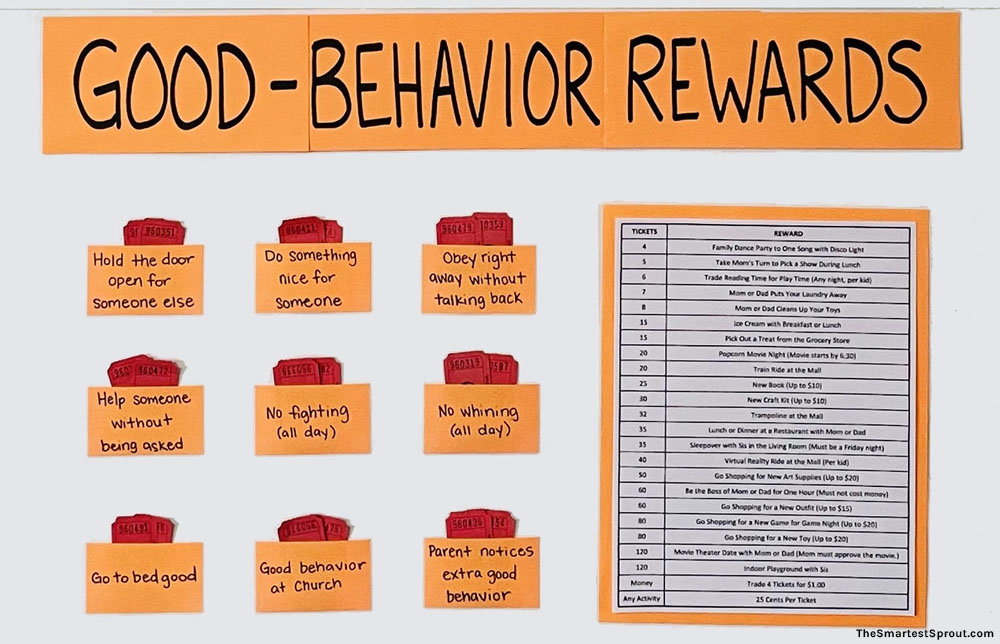
This section uses tangible rewards, that can be bought with good behavior tickets. Children can earn one ticket each time they show specific positive behaviors. This section is about 14 1/4″ high.
- Tape the “Good-Behavior Rewards” header to the top of the section.
- Similar to the “Paying Jobs” pockets, cut out and arrange 9 good behavior pockets, 2 1/2″ wide x 1 1/2″ high, and tape them to the board.
- On each pocket, write one good behavior your child needs to do in order to earn that ticket. Have several raffle tickets sticking out of each pocket. If you don’t have any tickets, you can create your own or buy them here on Amazon.
If you need ideas on what good behaviors to include, here are the ones I use:
-
Hold the door open for someone else
-
Do something nice for someone
-
Obey right away without talking back
- No fighting (all day)
-
No whining (all day)
-
Help someone without being asked
-
Go to bed good
- Good behavior at church
-
Parent notices extra good behavior
Next, you’ll need to make the rewards chart and tape it onto your poster board. You can make this by hand or with Microsoft Excel. The purpose of the rewards chart is to show all of the good behavior rewards available, and how many tickets each reward costs. I like each ticket to be worth about 25 cents for each reward that holds a monetary value.
Here are some of my favorite rewards we use at home:
- 7 tickets = Mom or dad puts your laundry away
- 20 tickets = Train ride at the mall
- 25 tickets = New book (Up to $10)
My rewards chart is 6 1/2″ wide x 8 1/2″ high, and I put a cardstock border around it for decoration.
Step 7: Build the Who’s Turn Is It Section (Fairness Tracker)
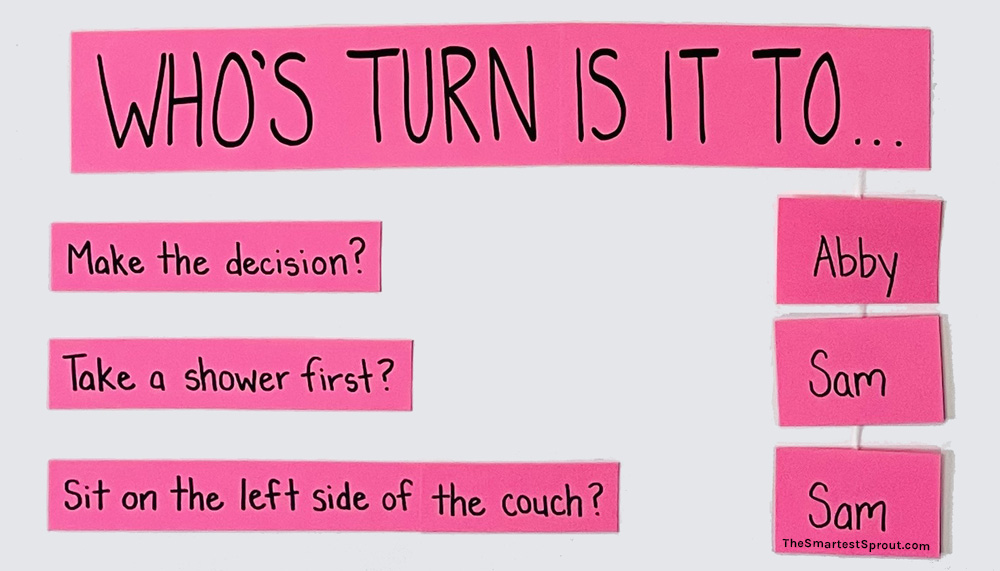
This section prevents daily arguments by showing who gets what. The footprint for this section is 12 1/4″ high.
- Tape the “Who’s Turn Is It To…” header to the top of the section.
- Write the question strips, cut them out and tape onto the poster board. The strips on my example are 1 1/2″ high.
- Cut out three rectangles from the cardstock, 3 1/2″ wide x 2 1/4″ high. Write one child’s name on three of the rectangles and your other child’s name on the remaining three rectangles. Cut three pieces of durable string or twine, each about 3 1/4″ long. Sandwich each piece of string between two of the opposite children’s names, back to back and secure with tape. Leave an inch of string hanging out of the top as a tail. Tape the tail of the string to the poster board. Please note this particular setup will only work with two children. Optional: Use velcro dots to secure instead of string.
Step 8: Hang It Up!
Hanging this large of a poster may feel daunting, but it doesn’t need to be. I hung mine up with a bunch of painter’s tape circles on the back and pressing it firmly against the wall. So far, it’s held up for nine months without falling once.
How to Introduce Your Kids to the Chore and Behavior Chart
How you introduce the chart matters almost as much as how you build it.
Don’t roll this out in the middle of frustration or after a rough day. A new system introduced during a meltdown will feel like punishment.
Instead:
- Gather your kids together when everyone is calm.
- Stand next to the chart and walk through each section.
- Explain what is required daily and what is optional.
- Clarify what earns money and what earns rewards.
- Explain how the turn taking prevents arguments.
Be confident and matter-of-fact. Avoid sounding apologetic or uncertain.
You might say something like:
“This is how we’re going to keep things running smoothly in our house. The chart shows what needs to be done, what you can earn for doing jobs and having good behavior, and how we’ll decide turns.”
Let them ask questions and clarify your expectations. Most importantly, follow through. If screen time requires toys cleaned up first, stick to it every single time. Consistency is what makes the chart powerful.
Why Visual Systems Work for Kids
Children process structure visually far better than verbally. When expectations live only in your voice, they feel flexible and emotional. When expectations are written down, they feel clear, predictable, and fair.
If you’re working on building consistency at home, the right discipline philosophy matters just as much as the structure you use.
That’s what makes this DIY chore and behavior chart for kids so effective.
A visual system reduces:
-
Repeated reminders
-
Power struggles
-
“You never told me!” arguments
-
Sibling fairness debates
It also builds independence. Instead of constantly asking, “What do I need to do?” kids can look at the board and answer their own question. And over time they begin to internalize the routine.
That’s the goal. Not just compliance, but ownership.
Unlike printable chore charts that get ignored after a week, this DIY chore and behavior chart for kids becomes part of your daily rhythm. It removes emotion, reduces negotiation, and builds responsibility through structure instead of reminders.
Final Thoughts
No chore chart will magically eliminate every complaint or argument. Kids will still have moments when they push back or test boundaries. That’s normal.
What a clear, consistent system does provide is structure. And structure reduces friction.
This ultimate DIY chore and behavior chart works because it separates required responsibilities from optional earning opportunities. It makes screen time expectations visible instead of negotiable. It reinforces positive behavior instead of focusing only on correction. And it builds fairness directly into everyday decisions that typically cause sibling conflict.
When expectations are posted and consistently followed, the emotional temperature of the home often drops. You are no longer repeating yourself constantly. Your kids are no longer guessing what counts. The board becomes the reference point instead of you.
The effort it takes to build the chart is small compared to the daily energy it can save. Clear expectations, visible rewards, and consistent follow-through create a calmer, more predictable environment.
And in a busy home, predictability can make all the difference.
Other Articles You May Enjoy:


Share This Page on Social Media:
Let’s Be Friends
Follow The Smartest Sprout on Facebook and Instagram! Discover the latest parenting tips, activity ideas, and more! Plus, get deal alerts on our favorite educational toys and healthy family essentials!